
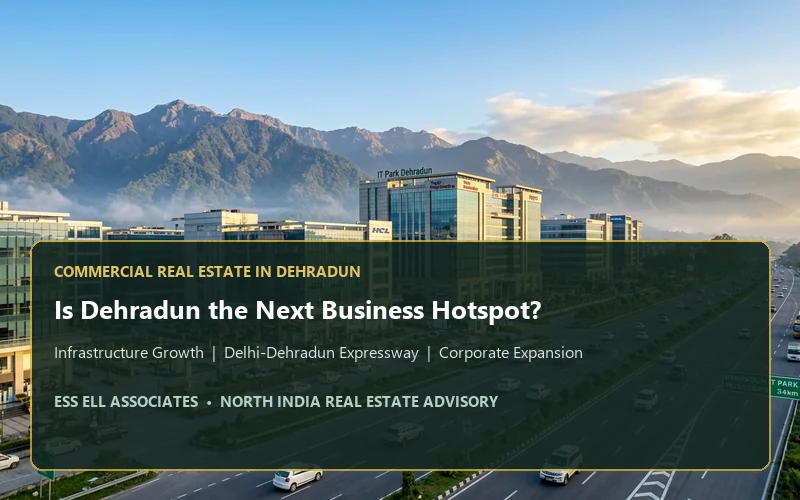
For years, India’s commercial real estate story was dominated by Delhi, Mumbai, Bengaluru, Hyderabad and Pune. But the business map is changing.
Companies are increasingly looking beyond expensive metros for new offices, regional branches, institutional facilities and expansion opportunities. Investors, meanwhile, are watching cities where infrastructure is improving before land and commercial assets become fully priced.
Dehradun deserves attention in that conversation.
The question is not whether Dehradun will “replace” a metro. It will not. The more relevant question is whether its connectivity, institutional ecosystem, airport traffic, expanding commercial corridors and proximity to Delhi-NCR are creating a stronger foundation for commercial real estate.
The data suggests that something meaningful is happening.
Why Dehradun Is Getting on the Commercial Radar
Dehradun is not simply a tourism-led market anymore. It is the capital of Uttarakhand and has a sizeable district population of 16.97 lakh. The district administration lists 34 banks, six colleges/universities and seven hospitals among its public-utility and institutional ecosystem.
That matters to real estate because commercial demand is rarely created by one industry.
A functioning business market needs employees, institutions, customers, education, healthcare, banking, professional services, logistics and residential catchments. Dehradun has several of these demand generators operating together.
For a developer, that creates a broader tenant pool.
For an investor, it creates multiple potential use cases rather than dependence on one sector.
The Delhi Connection Has Changed the Equation of Commercial Real Estate in Dehradun
One of the biggest developments is connectivity.
The 213-km Delhi-Dehradun Economic Corridor was inaugurated in April 2026. According to NHAI, the access-controlled corridor is designed to reduce travel time between Delhi and Dehradun from approximately six hours to around 2.5 hours. It also connects the region with Baghpat, Baraut and Shamli and integrates with major expressway networks.
That is not just a highway story.
For commercial real estate, better travel times can influence:
- Corporate expansion decisions
- Regional office locations
- Employee mobility
- Weekend and business travel
- Warehousing and logistics planning
- Hospitality demand
- Investor interest in peripheral corridors
The key real estate principle is simple: connectivity expands the economically usable geography around a city.
This does not automatically make every property valuable. It makes location selection more important.
The Airport Is Another Demand Signal
Dehradun’s Jolly Grant Airport is approximately 25 km southeast of the city. AAI describes connectivity to major cities including Delhi, Bengaluru, Jaipur, Pune and Ahmedabad.
Passenger numbers have also grown substantially.
AAI data shows total passenger traffic at Dehradun Airport increased from 6.47 lakh in FY2020-21 to 17.25 lakh in FY2024-25. During April 2025-January 2026 alone, the airport recorded 15.70 lakh passengers.
For investors, airport connectivity matters because commercial real estate is partly about time-distance economics.
A city that can be reached conveniently from major business centres becomes more practical for corporate travel, institutional operations, conferences, hospitality and regional management.
But Dehradun Is Not One Single Real Estate Market
This is where investors need to be careful.
Saying “Dehradun is growing” is too broad to be useful.
Different corridors serve different commercial purposes.
Rajpur Road: Established Commercial Identity
Rajpur Road is one of the city’s established premium corridors, connecting the central city towards Rajpur and Mussoorie.
It is relevant for:
- Premium offices
- Retail and branded businesses
- Restaurants and hospitality
- Professional services
- Institutional requirements
However, established demand also brings a problem – congestion.
Recent reporting has highlighted increasing traffic pressure around Rajpur Road and Mussoorie Road, linked to commercialisation, vehicle growth, parking issues and encroachments.
For a developer, this means an established address does not automatically equal a better development opportunity.
Sahastradhara Road: The Growth-and-Technology Corridor
Sahastradhara Road deserves particular attention from developers.
The state industrial development authority identifies the IIE IT Park Dehradun on Sahastradhara Road. The planned IT infrastructure spans more than 60 acres and includes provisions for technology businesses, developed plots, academic and research uses, incubation and business-support facilities.
That creates an interesting real estate ecosystem.
IT and knowledge-sector activity can support demand for:
- Office buildings
- Co-working spaces
- Business services
- Staff housing
- Food and convenience retail
- Healthcare
- Education-linked uses
The corridor has also seen considerable development pressure, making infrastructure quality, access, parking and planning increasingly important factors for property selection.
Haridwar Road, ISBT and the Southern Growth Belt
The southern side of Dehradun has a different commercial logic.
Haridwar Road and the areas around ISBT connect the city with Haridwar, Rishikesh and wider regional movement. They are more relevant when the requirement involves accessibility, larger-format commercial uses, institutional activity, logistics or businesses serving a wider catchment.
The city’s planning documents also identify major movement corridors including Rajpur Road, Haridwar Road, Saharanpur Road and Chakrata Road, while recognising congestion and intense land use in older commercial areas.
For developers, this creates an important distinction:
Central Dehradun is about established demand. Peripheral corridors can be about future demand.
Both can work – but they require different investment strategies.
The Industrial Link Makes the Market More Interesting
Dehradun also sits within a larger industrial and institutional network.
Uttarakhand’s State Industrial Development Authority lists the IIE IT Park Dehradun and IIE Pharma City, Selaqui among its industrial estates.
That matters because commercial property does not exist in isolation.
A company operating in technology, pharmaceuticals, education, healthcare or professional services can create secondary demand for offices, housing, food services, transportation, warehousing and other support businesses.
This is how commercial ecosystems deepen.
What Should Developers and Investors Actually Watch?
The strongest case for Dehradun is not “prices will rise.”
That is speculation.
A more scientific real estate approach is to track the underlying demand variables.
Look at these five indicators:
1. Connectivity
How quickly can employees, customers, suppliers and decision-makers reach the property?
2. Catchment growth
Is the surrounding residential and employment base expanding?
3. Institutional anchors
Are hospitals, universities, government offices, IT parks and industrial estates generating recurring activity?
4. Commercial absorption
Are businesses actually occupying space, or is development running ahead of demand?
5. Infrastructure capacity
Can roads, parking, utilities and public infrastructure support additional density?
A property that performs well across these five factors has a more defensible investment thesis than one marketed simply on “future appreciation.”
So, Is Dehradun the Next Commercial Real Estate Hotspot?
Potentially – but the answer depends heavily on where and why you are investing.
Dehradun has several ingredients that developers and investors typically watch: improving Delhi connectivity, an active airport, established institutional demand, technology infrastructure, industrial linkages and multiple expanding commercial corridors.
But the market is becoming more location-specific.
Rajpur Road, Sahastradhara Road, Haridwar Road, ISBT-side locations, Selaqui and other peripheral corridors should not be evaluated using the same investment logic.
That is why a requirement-first approach matters.
ESS ELL Associates’ Commercial Real Estate in Dehradun services works with businesses, institutions, investors, landlords and property owners to identify, shortlist and coordinate suitable commercial properties across Dehradun, Saharanpur and North India. Its approach starts with understanding the requirement before matching the property.
For developers and investors, that may ultimately be the most important lesson from Dehradun’s growth story:
Do not chase the “hotspot”. Understand the corridor, the demand and the property economics first.
Frequently Asked Questions
Q1. Why are businesses looking at Dehradun instead of bigger metros?
Dehradun offers improving connectivity, a strong institutional base, airport access and expanding commercial areas. For businesses, it can be a practical choice for regional offices, expansion or new operations, depending on their budget and location needs.
Q2. Which areas are important for commercial property in Dehradun?
Rajpur Road, Sahastradhara Road, Haridwar Road, ISBT, GMS Road and emerging peripheral corridors are worth considering. The right area depends on the business, customer access, budget and type of property required.
Q3. Is Sahastradhara Road good for commercial development?
It is an important growth corridor with technology and institutional activity, including the IIE IT Park. However, every property needs to be checked for access, infrastructure, permitted use and actual demand before investing.
Q4. Does better connectivity mean higher property prices?
Not necessarily. Better connectivity can make an area more attractive, but property value still depends on demand, supply, access, infrastructure, land use, property quality and future development.
Q5. What should investors check before buying commercial property in Dehradun?
Look beyond the location. Check title and approvals, permitted use, road access, parking, surrounding development, tenant demand, infrastructure, rental potential and resale prospects. Legal and technical due diligence should always be completed before investing.